
Mandala Moon Yoga, LLC
Find Mandala Moon on social media!
  • Home
  • Yoga Teacher Training
  • YTT Application
  • YTT FAQ
  • YTT Testimonials
  • Classes & Events
  • Locations & Pricing
  • Private/Corporate Classes
  • Class Cancellations
  • Our Teachers
    • Dena
    • Deb
    • Kristin
    • Eleanor
    • Patti
    • Andrea
    • Katie
    • Jhana
    • Mallory
    • Veronica
    • Janis
  • Contact
  • Kudos
  • Affiliations/Links
  • Photo Gallery
  • Newsletter Signup
  • Blog
  • MARI Readings
  • Yoga Book Club
  • iRest Series Evaluation
  • Customized Yoga Plan Survey
  • Yoga Breaks (Video)
  • Land Acknowledgement
  • COVID

Ganesh is Fresh

1/25/2026

0 Comments

 
Picture
In yoga spaces around the world, it’s common to see the image of Ganesh at the front of the room—steady, benevolent, and unmistakable. Pictured above is our own Ganesh statue, who has been with us since we opened the studio. Ganesh, the elephant-headed deity, is traditionally known as the remover of obstacles and the patron of beginnings. New ventures, new studies, and new chapters are often blessed by invoking Ganesh first, not to promise an easy path, but to invite wisdom, patience, and right relationship with what lies ahead.

In yoga philosophy, a “new beginning” doesn’t always mean something external or dramatic. Often, it’s subtle. It might be the willingness to meet your breath differently today than you did yesterday, or the courage to begin again after distraction, injury, burnout, or doubt. Each time we step onto the mat, we are practicing the art of starting fresh—bringing awareness to this moment, rather than dragging the weight of the last one along with us.

Ganesh teaches that obstacles are not mistakes or failures; they are part of the path itself. In yoga practice, these obstacles can show up as tight hips, a restless mind, inconsistent discipline, or resistance to slowing down. Rather than pushing through or bypassing what’s uncomfortable, Ganesh invites us to pause, bow, and ask: What is this here to teach me? Sometimes the obstacle is not meant to be removed, but understood.

There is also a gentleness in Ganesh’s energy that aligns beautifully with yoga. His large ears remind us to listen deeply—within ourselves and to one another. His curved trunk symbolizes adaptability, the ability to move skillfully around challenges instead of meeting them head-on with force. This mirrors the yogic principle of sthira sukham asanam: effort balanced with ease.

As we enter a new season, a new cycle, or simply a new class, Ganesh offers a grounding reminder: beginnings don’t require perfection. They ask for presence, humility, and devotion to the process. Whether you’re setting an intention, returning after time away, or standing at the edge of something unknown, yoga becomes a ritual of honoring that threshold.
​

You might begin your practice by silently acknowledging Ganesh—by name, symbol, or feeling—and setting an intention to meet whatever arises with curiosity rather than judgment. In doing so, you step into new beginnings not as something to conquer, but as something to befriend.

Try this mantra or intention practice:
​
Before a home practice, or as a meditation, come to a comfortable seat and take a few slow breaths, allowing the body to settle.

Bring to mind Ganesh as a symbol of steady wisdom and compassionate guidance. You don’t need to visualize him clearly—simply sense the quality of support, patience, and openness he represents.

Silently name or bring to mind what feels like a new beginning for you right now. It might be something tangible, like a new habit or chapter, or something quieter, like a shift in attitude or attention.

Then, softly repeat the mantra:

Om Gam Ganapataye Namaha

(I bow to the energy of Ganesh, remover of obstacles.)
Repeat the mantra three times, aloud or silently, letting the sound—or the intention behind it—create a feeling of spaciousness.

If mantra doesn’t resonate for you, use this intention instead:

“May I meet this beginning with clarity and kindness.
May obstacles become teachers.
May my effort be steady, and my heart remain open.”

Take one final breath, gently bow your head or hands, and begin your practice, carrying this sense of mindful beginning with you.

0 Comments

Muladhara - The First Chakra

4/10/2023

0 Comments

 
Picture
We live in a culture where we pay more attention to our gross anatomy (those parts visible to the naked eye) than we do to our subtle body. In this context, I am speaking of the physical parts of us—muscle and bone, organs, blood, skin, etc. If you’ve been a student of yoga for a minute, though, you know that yoga is concerned with more than just the physical body.

In yogic philosophy, we are composed of three bodies; the physical, the subtle, and the causal. The subtle body, also known as the astral body, includes energy, mind, and intellect.

Nadis are channels for energy in the subtle body, much like veins and arteries are channels for blood to move through the physical body. Chakras are “wheels” of energy created where the energy channels intersect. We have seven major chakras (pronounced with the “ch” sound, not the “sh” sound) in our subtle body. Each chakra is associated with a different element, sense, sound, color, gland, and part of the body as well as having a core psychological focus.

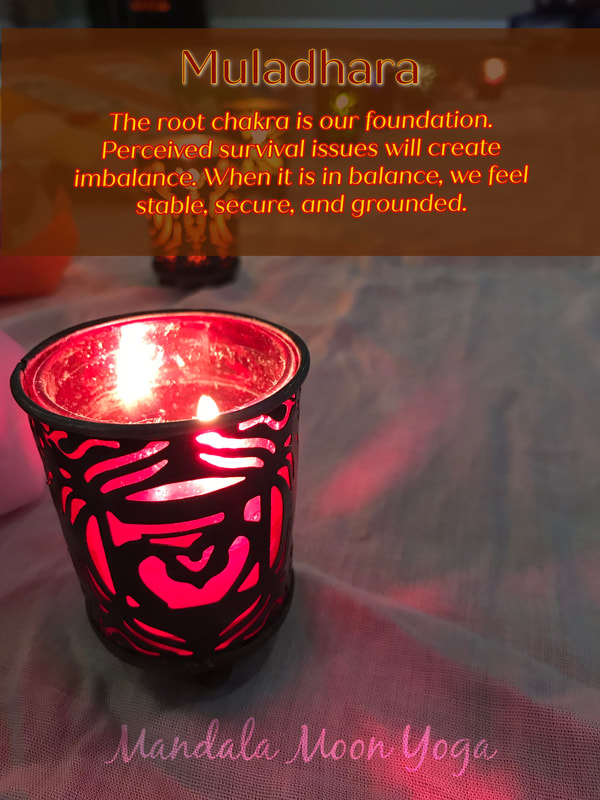
This post is an introduction to muladhara, the first chakra. Muladhara means root support. It is located at the base of the spine, and includes the legs, feet, and eliminatory system. The element associated with muladhara is earth, and it is associated with a sense of being grounded or rooted and feeling secure and stable. When our life seems out of control and our basic needs are threatened, we will be out of balance in this energy center. For instance, if we have financial difficulties, are going through career or relationship instability, or lose our connection to our close friends or family. To help balance muladhara, spend time outdoors, literally on the earth, walking, hiking, or gardening. Consider a grounding massage, drumming, or resting under a weighted blanket.

In our yoga practice, we can focus on strong standing postures, such as tadasana (mountain) and utkatasana (chair pose).

When you experience physical issues in the feet, legs, or with digestion, consider that it may be more than just your physical body. It could be your energy body sending you a message that you need to stand up for yourself and find more stability and security in your life.
0 Comments

    Dena D. Beratta

    Honored to teach, but always a student.

    Archives

    May 2026
    April 2026
    March 2026
    February 2026
    January 2026
    December 2025
    November 2025
    October 2025
    September 2025
    August 2025
    July 2025
    June 2025
    May 2025
    April 2025
    March 2025
    February 2025
    December 2024
    November 2024
    October 2024
    September 2024
    August 2024
    July 2024
    May 2024
    April 2024
    February 2024
    January 2024
    November 2023
    October 2023
    September 2023
    August 2023
    July 2023
    June 2023
    May 2023
    April 2023
    March 2023
    February 2023
    January 2023
    November 2022
    February 2022
    April 2021
    December 2016
    February 2014
    November 2013
    June 2013

    Categories

    All
    Alignment
    Apana Vayu
    Aparigraha
    Artha
    Asana (Poses)
    Autumn Equinox
    Ayurveda
    Balance
    Beginner's Mind
    Benefits Of Yoga
    Be Present
    Bhagavad Gita
    Bhakti
    Boundaries
    Brahmacharya
    Celibacy
    Chakras
    Citta Vritti
    Cookies
    Courage
    Devotion
    Dharma
    Diwali
    Durga
    Earth Day
    Easter
    FAQ
    Ganesh
    Gratitude
    Half Moon
    Halloween
    Hanuman
    Heart Openers
    Kali
    Kapha Season
    Kleshas
    Koshas
    Labor Day
    Letting Go
    Lion's Breath/Pose
    Love
    Loving Kindness
    Luck
    Meditation
    Memorial Day
    Metta
    Mindfulness
    Moderation
    Mothers
    Muladhara
    Niyamas
    Pancha Vayu
    Patanjali
    Polite Practice
    Pranayama
    Purusharthas
    Rebirth
    Samhain
    Sankalpa
    Sanskrit
    Self-study
    Shakti
    Showing Up
    Spring
    Spring Equinox
    St. Patrick's Day
    Stress Relief
    Summer
    Summer Solstice
    Svadhyaya
    Thich Nhat Hanh
    Tips
    Vata Season
    Weight Managmenet
    Winter Solstice
    Women's History Month
    Yamas
    Yoga Etiquette
    Yoga For Beginners
    Yoga Sutras

    RSS Feed

Call us: (315) 673-7535 or text: (315) 440-9125

Email: [email protected]