
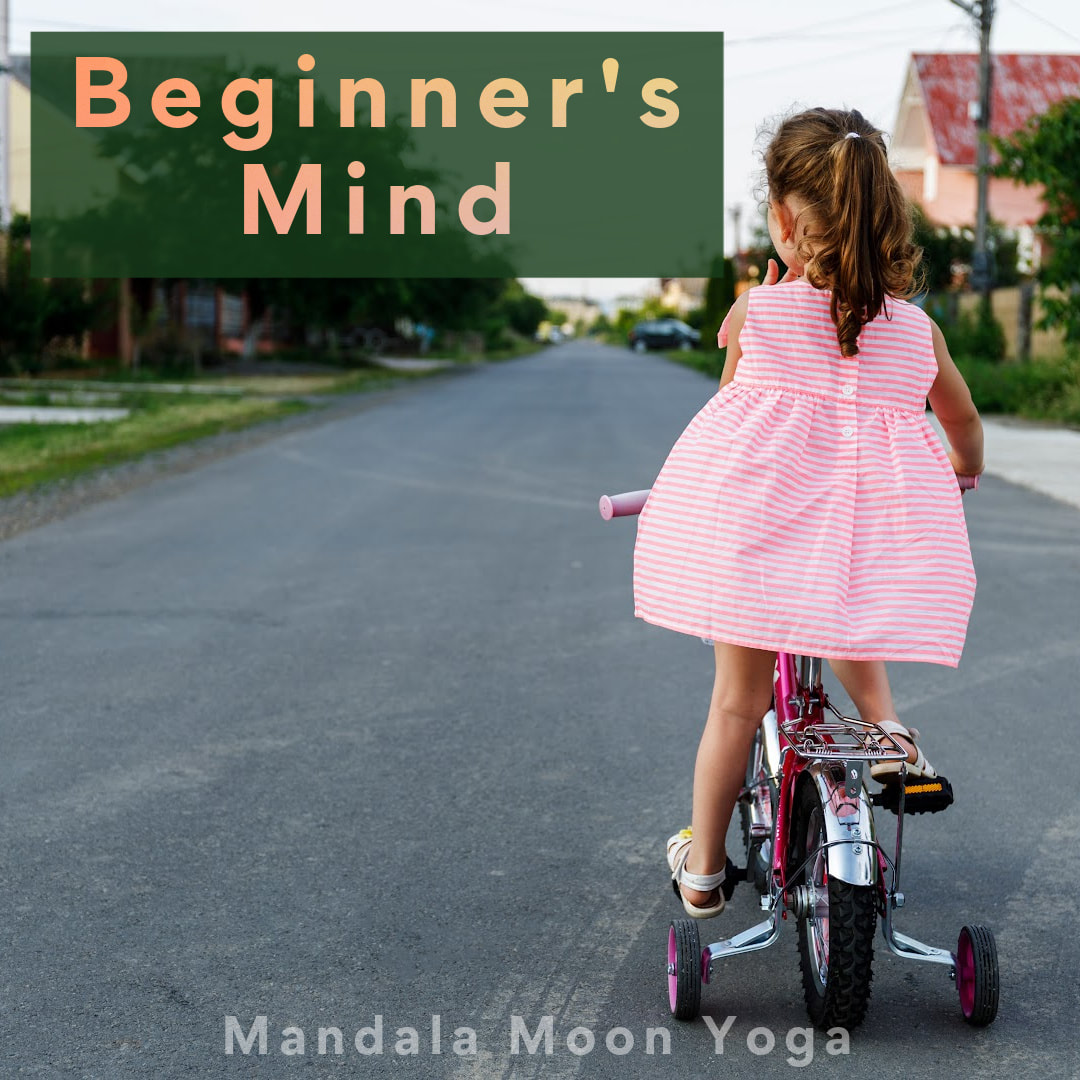
"In the beginner’s mind there are many possibilities, but in the expert’s there are few’." -- from Zen Mind, Beginner’s Mind by Shunryu Suzuki
Beginner's mind is a concept often credited to Zen Buddhism and applies to meditation. The idea is that when we meditate, it's important to go into it without expectations or an agenda, open to whatever arises and maintaining a state of acceptance and nonjudgmentalness. The concept is not limited to meditation, though. We can take our "beginner's mind" everywhere.
Here's what it might look like applied to your yoga practice:
Openness and Curiosity:
Carry the qualities of beginner's mind into your daily life, approaching new experiences with curiosity and openness.
Beginner's mind is a concept often credited to Zen Buddhism and applies to meditation. The idea is that when we meditate, it's important to go into it without expectations or an agenda, open to whatever arises and maintaining a state of acceptance and nonjudgmentalness. The concept is not limited to meditation, though. We can take our "beginner's mind" everywhere.
Here's what it might look like applied to your yoga practice:
Openness and Curiosity:
- Letting go of preconceptions: Approach each pose with a clean slate, ready to experience it as if it were the first time. Resist the temptation to move into postures in autopilot.
- Embrace the "not knowing." It's okay not to have all the answers or be able to "master" a pose. Be open to learning new details, adaptations, variations, and insights each time you step onto your mat.
- Fully inhabit the moment: Focus on the sensations in your body, the rhythm of your breath, and the feeling of your body moving in space. Don't get caught up in autopilot or thinking about what's next.
- Pay attention to subtle details: Notice the alignment in your fingertips, the subtle shifts in your muscles, and the way your breath changes in different poses.
- Be kind to yourself: Acknowledge your limitations and celebrate your progress, no matter how small. Release the pressure to achieve perfection and allow yourself to simply be where you are.
- Let go of comparison: Each body and journey is unique. Focus on your own experience and avoid comparing yourself to others.
- Deeper learning: Openness allows you to learn from every practice, whether it's a familiar pose or a new challenge.
- Increased enjoyment: Approaching things with curiosity and playfulness makes your practice more fun and engaging.
- Reduced stress and anxiety: Letting go of expectations and judgment helps you relax and connect with your higher self.
- Personal growth: Beginner's mind fosters a lifelong process of learning and self-discovery, both on and off the mat.
Carry the qualities of beginner's mind into your daily life, approaching new experiences with curiosity and openness.
 RSS Feed